
My daughter and I were recently debating whether to go to a concert. Neither of us was that excited about it, but somewhere in the back and forth, I noticed I was weighing something else entirely: whether going to the show was worth messing up my WHOOP data. (For context, the concert started at midnight.)
A night out with Jana, weighed against a recovery score… as if the two belonged on the same scale. In the end, I didn't let my WHOOP decide (we didn't end up going, but for entirely different reasons). But that I had done the weighing at all bothered me, which is what I want to reflect on here.
There's a lot being said right now about healthmaxxing.
Scott Galloway calls it “perfection maxxing,” how people are so attached to their numbers, they'll skip a night with friends. And then take entrepreneurs, investors, and biohackers who often go to extreme measures to reverse their aging. Maybe they will outlive us all, but I wonder if these intense protocols take away joy and spontaneity in life.
At some point, tracking your health stops being about living well and becomes a way of performing it. That's why I chose aliveness as my intention for 2025, and kept it for 2026 by doing the things that make me feel alive, even the ones that tank my recovery score. I can’t pretend that I have figured it out, but I am continuing to work on finding that balance.
First, the New Flex
I have been a loyal WHOOP wearer for over five years and I find the data immensely helpful. It enables me to turn my vague intention to be healthier into habits that have a generally positive impact on my life.
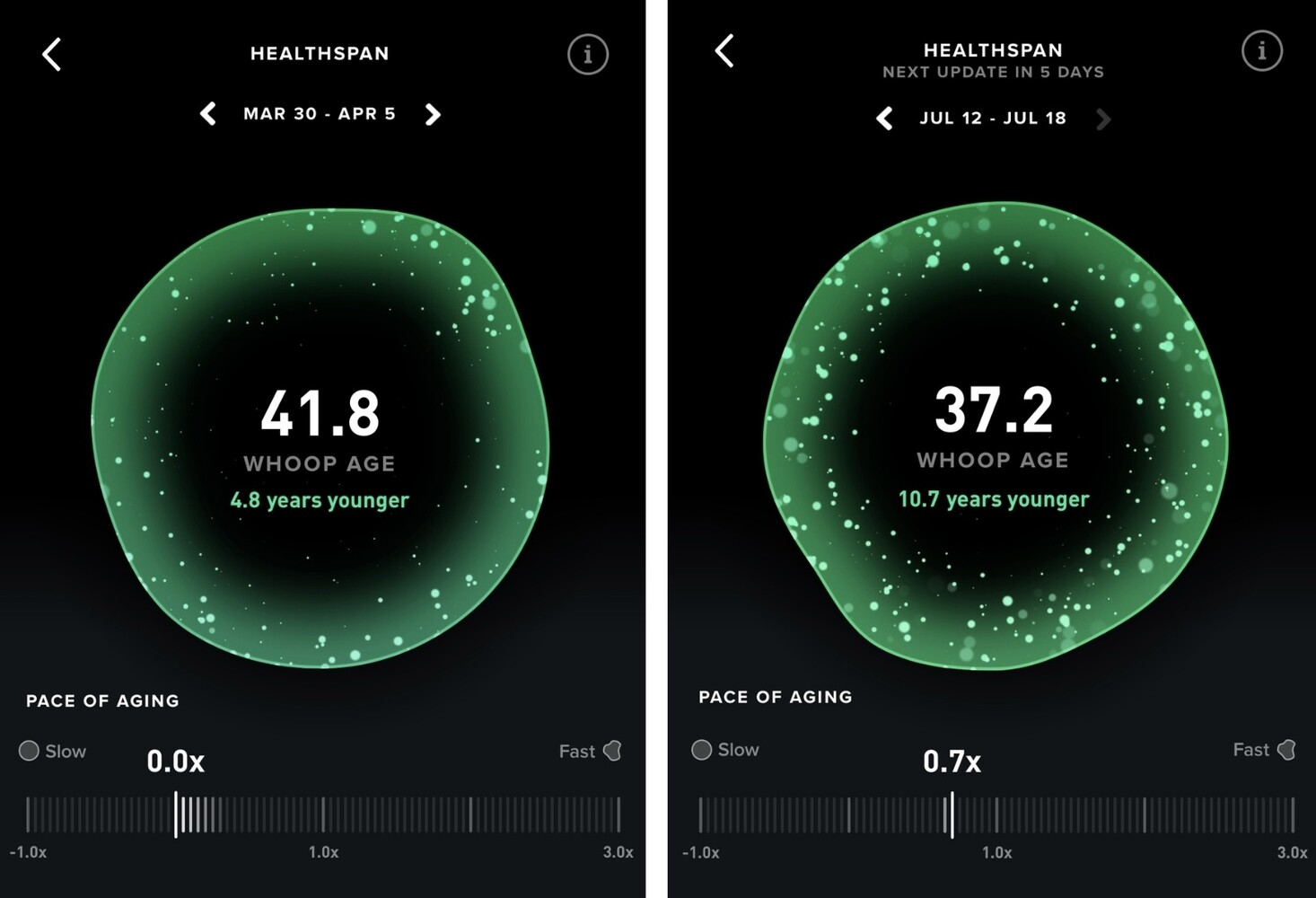
For me the WHOOP Age has been a game changer. About a year ago, WHOOP rolled out this feature, which combines your sleep, movement, heart rate, and several other health metrics into an estimate of your biological age and pace of aging. (And yes, I am very aware that it is an estimate).
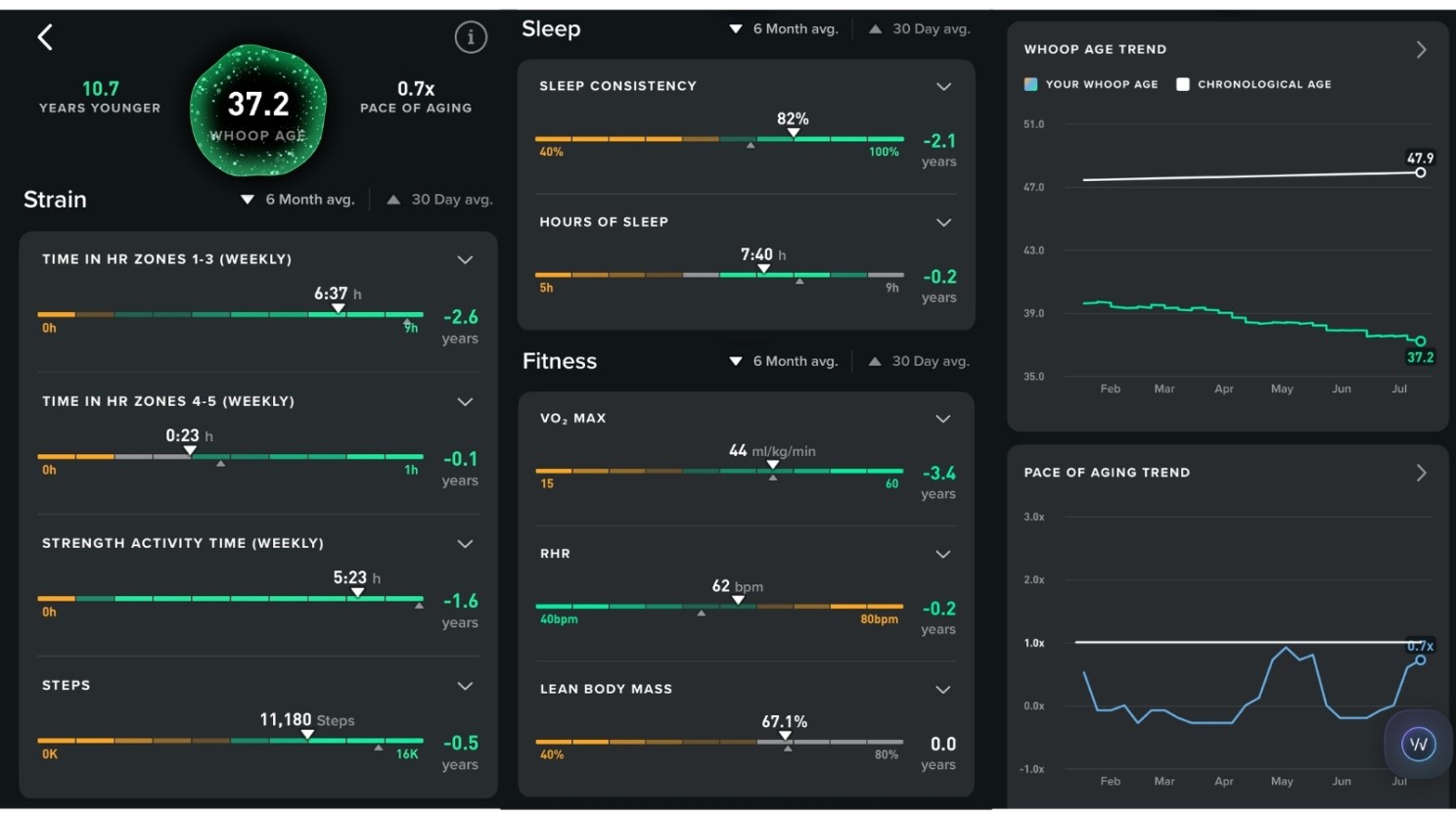
When I first started, I was 46 and WHOOP estimated my age at 41.8, or 4.7 years younger than my chronological age. I set the goal of my WHOOP Age being 10 years younger than my chronological age before I turn 48 this August. I hit that goal a few weeks ago. My WHOOP Age is now 10.7 years younger than my actual age. Woot woot!
Somewhere along the way, this WHOOP Age turned into a subculture. I'll be in a meeting and somebody clocks the band on my wrist. “Are you wearing a WHOOP? What's your WHOOP age?” Eight years younger, I'll tell the guys at the table (it is often men who ask me this). “You?” I ask back. “Ten years younger,” they might say. Then the phones come out, right there on the conference table, so we can show each other. It's a flex and also a funny kind of handshake, a way of saying I'm in this too.
This isn't a vanity thing.
WHOOP has changed how I think about my health. I've used it to run experiments on myself, testing different sleep, exercise, and eating patterns. When I walk an extra 5,000 steps a day, for example, I can add about two-tenths of a year to my projected health span. I realize that there will be plenty of people who will debate me on the scientific accuracy of WHOOP Age and that’s fine. The point is, it has given me an actionable framework for helping me make better decisions about my body and health.
It Logged the Dance, Not the Joy
But for everything my WHOOP knows about my body, it knows much less about my life. While it has a number for everything I did that day: my strain, my recovery, my heart rate, how I slept, it doesn't know the context of my activities or have a thing to say about what any of it meant.


I’m an avid Zumba dancer. In April, my WHOOP logged a dance session. From a cardio standpoint, this was entirely accurate and closely resembled one of my Zumba workouts. But WHOOP had no idea that I was dancing at my cousin’s wedding in Egypt, or that I was so joyful, my heart so full, that I spent half the night in tears. It captured my movement and heart rate exactly right. But it understood nothing about the night.

I’m writing this as we head into the final week of the World Cup. Depending on where you are in the world, following the tournament has required some very odd hours. My 19-year-old niece, Amina, a HUGE soccer fan, stayed up to watch Egypt play at 4 a.m. Did it destroy her WHOOP scores? Absolutely! But she watched alongside hundreds of friends and witnessed Egypt win its first World Cup match in 92 years. Now that is priceless!
When I reflect on what experiences matter most over the course of a year or lifetime, it’s the wedding, the friendships, the hours engaged in meaningful connection.
The numbers were never the point.
Emotion-maxxing
I have spent my career working on this exact problem that as much time as we spend with technology, it often doesn’t understand our emotional and mental state. I founded Affectiva on the premise that most of how we feel isn’t always reflected in our words at all. It’s in our faces, our voices, the heart racing, our goosebumps. We spent years teaching machines to read human emotions through analyzing facial expressions. And yet, today, I wear a band that can track my heart rate to the decimal but has almost no idea how I’m feeling or experiencing while it does.
The Data Gets a Vote, But It Doesn't Get the Final Say
I love my WHOOP. I also know its limits. It has helped me build healthier habits and understand my body in ways I couldn't before. But I never want to confuse measuring my life with living it.
But I never want to confuse measuring my life with living it.
Sure, the data gets a vote, but it doesn't get the final say. As humans, we get to decide whether staying up for a concert or a World Cup match is worth it. The day I let my recovery score make those decisions for me is the day technology stops working for me and starts running me.
That concert with Jana was an honest moment when I caught myself asking whether a night out was worth the hit to my recovery score. For all my WHOOP knows about my body, it doesn't know everything. The part it can't see, the part that decides what's worth doing and who's worth doing it with, is the most human thing I have.
That's the part I'll never outsource to a machine.